
 By K2rankings
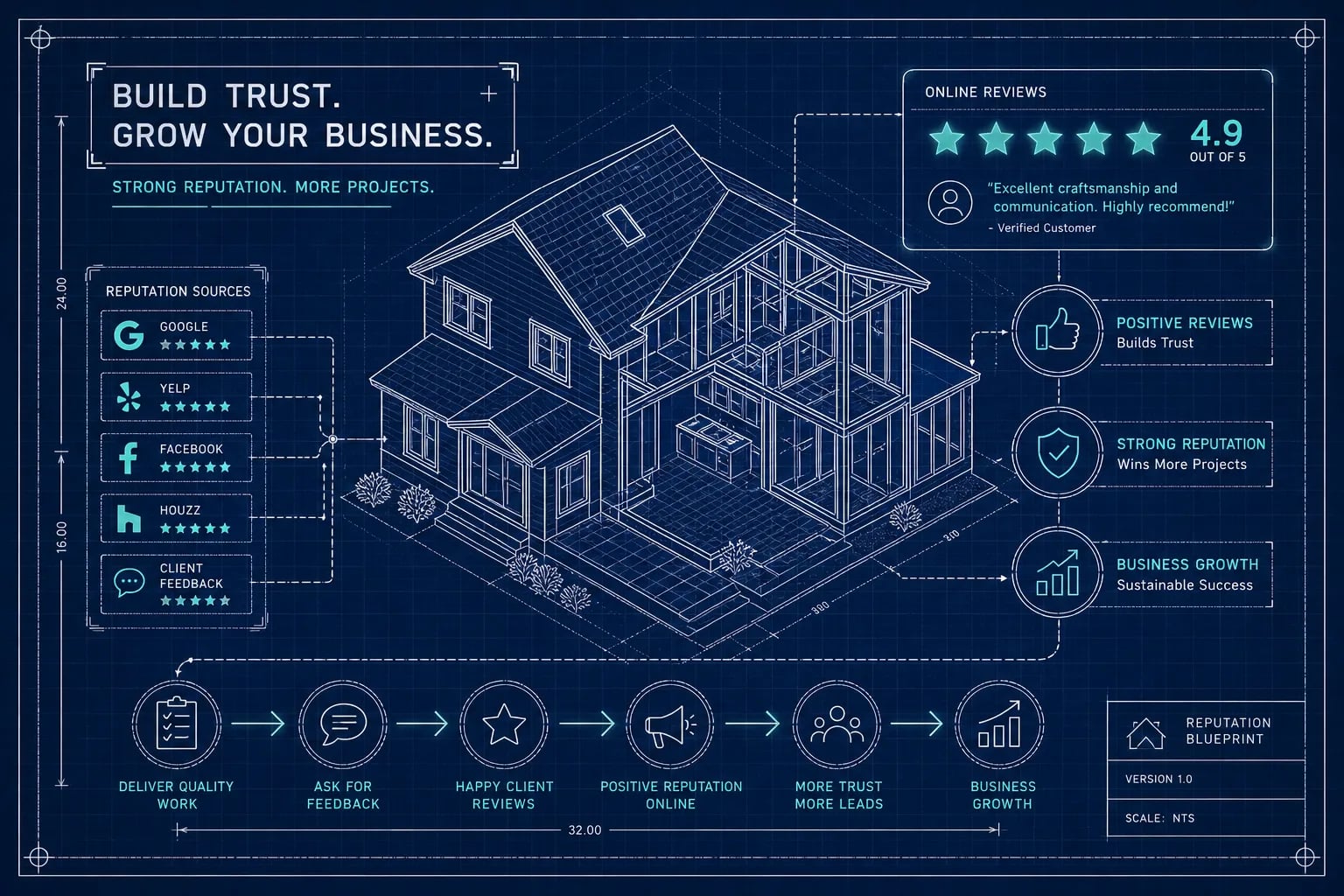
Your online reputation for remodelers is the single highest-leverage asset in your marketing stack, and it controls who calls you before they ever visit your website. According to HomeProBadge, 91% of homeowners rely on online reviews before hiring a remodeling contractor. The 4.5-star threshold is where that conversion math becomes concrete: according to WebTonic, 31% of homeowners will not hire a contractor rated below that mark, and according to Search Science Agency, 86% skip those rated 4.0 or below entirely. Those are real projects walking directly to a competitor right now.
Most remodelers face problems that keep their reputation from working as a lead generation asset: inconsistent review volume, no response system, and scattered or unclaimed listings across the platforms that actually matter. This guide gives you a repeatable process to audit where you stand, build steady review velocity, respond in ways that win future business, and tie it all into your local search rankings.
Key takeaways
- 4.5 stars is the floor: Ratings below this threshold eliminate you from consideration for the majority of homeowners before a single conversation happens.
- Volume and recency matter: A 4.7-star profile with 80 recent reviews outperforms a 5.0 profile with four old ones in the eyes of homeowners.
- Google Business Profile is non-negotiable: It is the most visible platform and carries the most weight for local search rankings and Map Pack placement.
- Review requests need a system: Asking every completed client consistently is the best practice recommended by FTC and platform guidelines, and it outperforms sporadic pushes.
- Responses are public marketing: How you handle a negative review tells every future homeowner how you handle problems on a job site.
- NAP consistency protects rankings: Mismatched name, address, and phone data across listings erodes the local SEO signals that drive Map Pack visibility.
Why ratings directly control how many projects you close
The 4.5-star threshold is not a guideline; it is a filter homeowners apply before they scroll past a contractor. According to Search Science Agency, 86% of homeowners skip contractors rated 4.0 or below.
Review volume carries almost as much weight as the rating itself. Homeowners consistently choose a contractor with a 4.7-star average and 80 reviews over a perfect 5.0 built on four reviews. Recency compounds this: a wave of reviews from two years ago signals stagnation, while a steady stream of recent feedback signals an active, in-demand operation.
The Google Map Pack surfaces this information before a single click happens. On a mobile screen, the star rating, review count, and lead photo form an immediate first impression, within seconds of the page loading. Visibility of good work is what fills the calendar, not good work alone. A contractor with a beautiful portfolio buried under a 3.9-star average loses the job to the 4.6-star competitor whose listing is dialed in.
Which platforms should remodeling contractors actually prioritize?
Not every platform delivers equal value for a remodeling business. Google Business Profile is the non-negotiable foundation: it appears in Google Maps, local search results, and the AI-generated overview panel. For a homeowner searching “kitchen remodeler near me,” the GBP listing is the first encounter with your business. Claims, verification, service-area setup, and a full photo library are table stakes before anything else gets built.
Houzz earns serious attention as a secondary priority. It attracts homeowners who are actively planning a renovation, not casually browsing, and a fully built portfolio here converts design-forward clients who are already in buying mode. Facebook works differently: local groups, neighborhood recommendations, and page reviews function as referral-based discovery. When a homeowner Googles your business name after getting a neighbor’s recommendation, a strong Facebook presence reinforces credibility at that exact moment.
Yelp and Angi serve as reputation coverage and lead testing channels rather than primary drivers. Across all five platforms, the discipline that ties them together is NAP consistency. Your name, address, and phone number must be identical everywhere, inconsistencies confuse search engines and erode the local ranking signals that push your profile into the Map Pack.
| Platform | Best use for remodelers | Lead quality | Priority tier |
|---|---|---|---|
| Google Business Profile | Capture high-intent local searchers | Very high | Primary |
| Houzz | Portfolio showcase, design-forward clients | Highest for large remodels | Primary |
| Referral discovery, local groups | High via word-of-mouth | Secondary | |
| Yelp | Reputation coverage, branded search | Moderate | Supporting |
| Angi | Lead volume testing | Variable | Supporting |
How to build a steady flow of 5-star reviews
The final walkthrough is the highest-conversion moment for a review request. At that point, the client has inspected the work, any outstanding issues are resolved, and the experience is fresh. Asking a client who still has unresolved concerns risks a public negative review instead of a private conversation where you can fix the problem first.
In-person closeout scripts for requesting reviews
Scripts matter because vague asks get ignored. For the in-person closeout: acknowledge the project, confirm satisfaction, then make a single low-pressure ask with a direct link ready on your phone. Keep the moment natural, you are not reading from a script, you are following a practiced structure.
Email and text follow-up to strengthen your online reputation for remodelers
For email, keep the subject line simple, lead with a one-sentence thank-you, drop the direct link, and include a clear note that no specific rating is expected. For text, stay under 50 words with a mobile-formatted link and zero pressure language. Send one follow-up reminder at 7 to 14 days, then stop.
The FTC prohibits conditioning reviews on incentives or favorable wording. Never offer a discount in exchange for a five-star rating, and never direct only happy clients to the review link while routing dissatisfied clients elsewhere. Google’s policies explicitly prohibit review-gating, and civil penalties for FTC violations can reach $53,088 per violation, according to current FTC guidance. The safe rule: invite every completed client, request honest feedback, and apply the process consistently after every job.
How to respond to reviews in a way that wins future business
Every review response is public marketing. Structure every positive response the same way: thank the reviewer by name, reference the specific project type, reinforce one value delivered, and invite future contact. A generic “Thanks!” reply misses the opportunity to add location-relevant, keyword-rich language that strengthens local SEO while demonstrating that a real person is paying attention. Respond within 24 to 48 hours across all platforms.
Negative reviews require a different formula, and the discipline to execute it calmly. Acknowledge the concern, apologize for the experience without assigning blame, then move the conversation offline with a named contact and direct phone number. Never argue publicly, disclose invoice details, or deny the experience outright. Prospective clients read the response more closely than the original review, and a calm, professional reply to a one-star complaint tells every future homeowner exactly how your business handles problems on a job.
Neutral or vague three-star reviews deserve responses too, not write-offs. Respond with a short acknowledgment, reference the project type, and invite the client to share specifics through a direct channel. Following up privately often converts a lukewarm reviewer into a repeat client who feels genuinely heard.
How reputation signals feed your local search rankings
Google’s local ranking algorithm weighs review volume, rating average, recency, and the text content of reviews as prominence signals. A client who writes “kitchen remodel in [city name]” in their review carries more local SEO weight than one who writes “great work.” That natural language reinforces your relevance for location-specific searches without any keyword stuffing required.
Responding to reviews is itself a positive engagement signal that is widely understood to register on your GBP profile. Beyond direct ranking influence, a high-rated profile improves click-through rate from both paid search ads and organic listings simultaneously. Reputation signals compound: a stronger profile improves local SEO, which lowers cost-per-lead across every channel you run, paid and organic alike.
Homeowners who see consistent five-star reviews across Google, Houzz, and Facebook are more likely to complete a contact form when they land on your website. The reputation infrastructure you build on external platforms gives your website the authority to convert once the traffic arrives.
Should you manage reputation yourself or bring in a system?
Several tools make DIY contractor review management feasible for a small remodeling operation. NiceJob automates SMS and email review requests after project milestones with minimal setup friction. BrightLocal is a strong choice when local SEO rank tracking needs to be managed alongside review collection. GatherUp adds NPS surveys and monitoring across 100-plus sites, which is useful when customer feedback data matters as much as star ratings. Check each vendor’s current pricing page for up-to-date plan costs.
The honest limitation of any DIY tool is simple: it only works if someone at the business consistently runs it after every single job. Many firms find it difficult to sustain that discipline without a dedicated owner or designated staff member accountable for the process. A busy season has a way of crowding out reputation management when it is treated as optional.
For a business at that project level, the cost of a missed review or an unanswered complaint far exceeds the cost of having it managed properly.
Your reputation is a system, not a byproduct
Building a strong online reputation for remodelers is not something that accumulates on its own as a reward for good work. It is an active, manageable system: claim and optimize your listings, build consistent review velocity, respond to every review on every platform, let those signals strengthen your local SEO, and choose a tool or service that makes the process sustainable long-term.
Track two metrics above everything else: your rating average, using 4.5 as a directional floor and 4.7 to 4.8 as a target range per industry benchmarks, and your review velocity, meaning new reviews per month rather than a running total. The remodeling contractors who dominate their local market over the next three years will be the ones who treat reputation as a core business function, with the same discipline they apply to estimating and project management.
If you want the entire process handled and integrated with your lead generation strategy, contact K2 Rankings Tech to have the full reputation management system built and running inside your business. Getting your online reputation for remodelers working as a consistent source of booked projects is exactly what it is designed to do.
Frequently Asked Questions
How often should we request reviews from completed projects?
You should ask every completed client consistently. Asking at the final walkthrough produces the highest conversion, and sending one follow-up reminder at 7 to 14 days is the recommended cadence before stopping.
What specific metrics should we track to know our reputation system is working?
Track your rating average and your review velocity as the two primary metrics. Use 4.5 stars as the directional floor and 4.7–4.8 as a target range, and measure new reviews per month rather than just a running total.
Can a stronger reputation actually lower our lead costs for paid advertising?
Yes, a stronger reputation lowers cost-per-lead across paid and organic channels. A high-rated profile improves click-through rates and local SEO, which compounds to reduce acquisition costs across every channel you run.
What should we do about inconsistent name, address, and phone (NAP) data across listings?
You must make NAP data identical everywhere, because mismatched entries erode local SEO signals. Consistent NAP protects your local rankings and helps push your profile into the Google Map Pack.